







By Meera Srinivasan/The Hindu
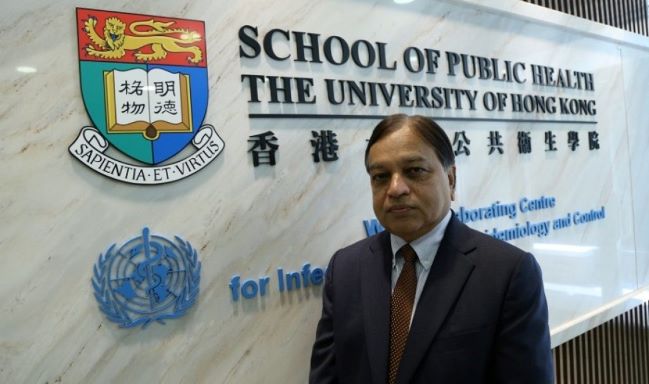
Colombo, Jun 15: For decades, renowned virologist Malik Peiris has been researching emerging viruses at the animal-human interface, including influenza, coronaviruses (SARS, MERS), and is widely credited for his role in discovering that a novel coronavirus was the cause of SARS in 2003. The Sri Lankan-origin expert, who holds the Chair of Virology at the School of Public Health in Hong Kong University, detailed how COVID-19 is different from the other outbreaks and suggested that the world could have been better prepared but for its over-reliance on the pharma industry. Here are excerpts from an interview given to Meera Srinivasan of The Hindu:
Meera Srinivasan: What is your assessment of the COVID-19 pandemic, which began late last year and has now spread all over the world?
Malik Peiris: Well it has spread to most parts of the world. But it is inevitable that as a virus that is efficiently spreading from human-to-human, it is going to continue to transmit. It is also clear that the [SARS CoV2] virus behaves very differently from SARS and that is why it is much more difficult to contain it. This is particularly because of two reasons. One is that in the case of SARS, most of the transmission took place five or six days after the patient developed symptoms. So, the first few days after a patient was ill, there was very little transmission. But in the case of COVID-19, patients are transmitting immediately from the time they develop symptoms and even before. When they transmit even before they develop symptoms, it becomes very difficult to control.
The other big difference is that whereas with SARS most of the patients who got infected had symptoms, in the case of COVID-19, it is clear that quite a number of patients, who get infected, have no symptoms at all.
So, with these two things, it makes it very difficult to contain. In the case of SARS if you could detect, diagnose patients very early, after they develop symptoms, and get them into hospitals, then the transmission in the community can be stopped. That is how the virus was controlled, right? There was no vaccine or anti-virals, so it was purely diagnosis and isolation of patients.
But with this virus you can’t do that, because some patients are transmitting even before you know they are sick. Early diagnosis is important, but you have to get ahead of the virus. As I explained, just diagnosing the patient as soon as he or she gets symptoms by itself is not sufficient. You have to find out whom this person was exposed to and put those people in quarantine in advance, because there is usually an incubation period of about five days before they develop symptoms. Contact tracing and quarantine are very important to break the chain of transmission.
In different contexts, the response to the virus has been different. New Zealand has recently declared itself virus-free and is preparing to further open up. How can countries with large and dense populations, like you have in South Asia, where public health infrastructure is uneven, get ahead of the virus? Sri Lanka or Kerala seem more equipped than many other places…
Yes, this is really where the public infrastructure becomes so crucial because in order, first and foremost, to have the testing, contact tracing, quarantine, you really need a good public health infrastructure. In the absence of that the only other tools you have are the lockdowns.
Basically, what you are doing with the lockdown is you bottle the virus up into individual households. If one person in the household is infected, it may infect other people in the household, and then some people may get more seriously ill and will have to be looked after in hospital. But then, there is no transmission from one compartment to another. That is the logic of the lockdowns. China has shown that it does work if implemented very vigorously and aggressively.
Then again, for many Asian, South Asian countries, it can be very difficult to implement this effectively. On the other hand, even if it implemented effectively, as in the case of China, it could have very serious economic implications. Nevertheless, China shows us how after completely suppressing the virus, they could open up quite quickly.
So, it all depends on how effectively you do this and stamp out the virus more or less, like in New Zealand for example, and then you can relax to some extent. Even then, you do have to have in place surveillance measures at the population level to warn people of the re-emergence of the virus.
After all, the virus is there is many parts of the world. So even if you manage to stamp it down in your own area, it is likely to come back in. So many places like New Zealand and Australia have travel restrictions. People coming in from outside are restricted, and if they do come in, they have to be quarantined for 14 days. With these measures, you can reduce the introduction from outside, but again, for large South Asian countries, this certainly can be quite challenging.
MS: What is your view of the extent of testing needed? There is a call for random testing from some.
MP: I am advocating very aggressive testing of people who have any form of respiratory infection. First and foremost, all patients with pneumonia, with no other clear diagnosis. [Then] patients with fever and cough or flu-like illness, which can be caused by many viruses — but COVID-19 also presents like that. For many South Asian countries that will already be quite a lot of testing to be done. Understanding that, I would not go so far as to talk about random testing.
In Hong Kong, we were essentially able to control the disease. We went for about 23 days without a single local case. But then we had one cluster of a household where the husband and wife were affected. And after another two days, another separate cluster. This means the virus is spreading underground if you like, almost asymptomatically, and giving rise to these clusters. This is why in Hong Kong people have been arguing for random testing.
But the problem is, even in Hong Kong — our testing capacity is quite adequate — in this most recent cluster of cases detected, that patient had been to the GP three times, but not tested. So, although the testing is there, the healthcare providers are not using it effectively. For a start, what I would certainly say for South Asian countries is test all patients with pneumonia without any known diagnosis. Secondly, if you have capacity go down to what is called influenza-like illness. For this you have to mobilise the accident and emergency [wards] and the general practitioners to submit specimens. When you try to do that level of mass testing, it is quite difficult to collect swabs in the way that we normally do which is a nasopharyngeal swab, which requires a trained nurse or doctor.
In Hong Kong, we have found that saliva testing is very effective. You don’t even need a doctor to collect that specimen. All that a patient has to do is to collect a deep throat saliva – you clear your throat and just spit out into a container and send that to the laboratory. That can be certainly done. You have to use all these measures together.
MS: From your study of the viruses, do you see different strains of it that manifest with different intensities in patients?
MP: It is an RNA virus and RNA viruses undergo mutation as they spread. With that mutation, if you sequence the genome of the virus you can identify different patterns. When the virus is spreading in one particular area — obviously all the viruses are very closely related — they may acquire very characteristic mutations. In another area, they may acquire other characteristic mutations. These mutations can be used to try and trace who gave the virus to whom and also look at the virus that came into your country and trace which part of the world it came from, because of these signatures. But it does not mean that these strain variations are related to any difference in severity. There is no hard, scientific evidence showing there are highly virulent strains and less virulent strains — that is not the case.
The virus can be very mild in many people. In some people, particularly older people who have underlying heart or lung diseases or diabetes, it can be quite severe. This is the typical pattern of the disease and this hasn’t changed necessarily.
MS: The reason I ask is because we read reports, for instance, of a person aged over a 100 years recovering well somewhere, and a young patient with no known illness succumbing to the virus elsewhere…
MP: It is to do with the individual and also the infecting dose. If somebody gets infected with a very large dose, then the chances are that the person will get much more severely ill. Always, this is a race between the virus replicating as fast as it can and the body’s immune system trying to respond as fast as it can. If you get infected with a very low dose of virus, there is enough time for the body to start responding before the virus builds up to a large level. The body’s own immune system can cope with it.
A third variable is the type of infection. I don’t have proof for this, but I say this based on what we know about other viruses like influenza. If, for example, you get infected through very small air-borne particles, which you breathe in straight into your lungs, then the disease is likely to be more severe. Whereas if the virus gets just into your nose, say through your hands, the chances are that the disease may be less severe.
So, these are the factors — patients’ own genetic differences, but certainly, more importantly, underlying health issues, age; the dose of virus you get infected with, and the manner in which it infects.
This is why, as you say, we hear of this 100-year-old person who fortunately recovered and a younger person who unfortunately succumbed. But again, if you look at it at a larger scale level then you still have the pattern — if you look at 100 people over 65 people, who get infected, you will find 4% to 6 % of these people may die. Whereas if you look at 100 infected people who are 20 to 50 or 60 years, probably less than 1% would die. If you go even younger, all 100 might not only survive, but not show any symptoms at all. So, you have this gradation, but the case of the individual can vary very much, because all these factors come into play.
MS: Isn’t the treatment a fourth variable? Or is it generic, with few chances for lapses?
MP: Of course, good treatment is important. But that is particularly important in those patients who get severe disease. Doctors are under a lot of pressure to do something.
People are talking about chloroquine and this and that, and unfortunately, we don’t have any good evidence that many of these things work. Except for this drug Remdesivir, for which there is more and more evidence that it is beneficial for patients. There may be other drugs that are effective. A trial in Hong Kong showed that a combination of a drug called Kaletra, which is used to treat HIV patients, together with interferon beta is beneficial, but again it was not a completely randomized trial, meaning it was not compared with people who didn’t get any drug. I think it is important not to panic and think you have to prescribe something.
Obviously, there are a lot of things hospitals and doctors can do to make sure the patient is well — give symptomatic treatment, give oxygen when the patient requires, or if needed have ventilation when required. Those are all things that can be done. Depending on whether you do those things properly, treatment can improve or worsen a patient’s chances of survival.
MS: From your research on different viruses, what has Covid-19 shown us about the human body, our immune system and resilience? Is it telling us something we didn’t know before?
MP: To be honest, probably not. Many of us who have been studying these epidemics for quite some time, were predicting that we were going to get a very serious epidemic sooner or later. If you look at the last 25 years — in 1997 we have had avian flu H5N1, in 2003 we had SARS, in 2009 we had the swine flu–H1N1 pandemic, in 2013 we had MERS in the Middle East, in 2014-15 we had Ebola and in 2018 we had Zika.
Every two or three years we have had completely new epidemics. Until this one, every time, we have managed to dodge the bullet so to speak. In the case of SARS as I explained to you, it was possible, with great global cooperation and aggressive diagnosis and public health measures to stop it, which was amazing. In the case of the 2009 pandemic it just went like a bomb but luckily it was very mild. This is why many of us were saying we can’t keep on being lucky every time. Sooner or later, one of these viruses is going to be nasty, and this is it.
To that extent, I am afraid it is not a surprise. What is sad is that we have been warning that we need to take measures to prepare vaccines for coronaviruses — we already had SARS, we had MERS — so we knew that these viruses were quite dangerous.
We know that influenza causes pandemics, so for that at least, some measures have been taken. But I am afraid it is this lack of preparedness that has left the world vulnerable to this pandemic.
MS: When you say lack of preparedness, what specifically should have been done in your view?
MP: When SARS emerged, everybody was jumping up and down, the whole world was excited, it was a huge economic loss, and everybody was really very concerned. But then, it was controlled. In 2003, many groups across the world including ourselves in Hong Kong, we were developing drugs and vaccines for SARS.
We developed them in the test tubes, we tested them in animal models but then we needed to take the next step of human clinical trials, which is very expensive. By that time SARS had been controlled. There was no more funding or interest to take these experimental vaccines further. It all stopped there. If we had taken those further, we would have at least known how to make a vaccine for this group of viruses. And when COVID-19 came it would have been just a matter of using the same strategy.
But at the moment, we are basically starting from scratch. We don’t have a single vaccine for coronaviruses. As you know COVID-19 is not the only coronavirus that infects humans; there are a number of them and there are many coronaviruses that infect animals as well. We are starting afresh this time.
Until now, our model has been to rely on the pharmaceutical industry to make vaccines and drugs. But when you think about it, that model does not work with these types of novel emerging infectious diseases with pandemic potential.
How can a vaccine company, whose motive is profit, invest millions and millions? It’s a huge amount of money that you have to invest to take a vaccine all the way to clinical trial and efficacy trial – when there is no certainty that this vaccine is going to be needed? If you take SARS, no pharmaceutical company was interested in any of our vaccines because there was no demand. This is the problem.
This is why many of us were saying we need a different model to develop vaccines and anti-virals for these novel emerging infectious diseases.
Indeed, this was listened to [by some] and there was this organization called Coalition for Epidemic Preparedness Innovations (CEPI), it was coordinated by WHO, funded by Bill Gates and others – they started working, and they had prioritized a number of viruses for vaccines and anti-virals. One of them was MERS, a coronavirus, other one was Ebola. But this pandemic came before all those could provide results. This is where at the international level, we need to take more coordinated action, and we cannot just rely on the pharmaceutical industry to respond to these issues
MS: Do you mean national governments and international organizations have to work on such a response and preparedness with a public health focus?
MP: Yes, exactly.
MS: You spoke of an individual’s immune system and how that contributes to one’s chances of survival. We are constantly hearing different claims around boosting the immune system – from turmeric to ginger to tea. What do we make of these?
MS: I don’t think there is any evidence that ginger or turmeric or anything like that has any effect. Of course, leading a good lifestyle with a lot of exercise, fresh air, and outdoor activities are good for overall health. It is good for your cardiovascular strength, your respiratory system. If your heart and lungs are functioning well, then you are much better placed to fight a disease like COVID-1. We know that regular exercise enhances your immune responses as well.
MS: How do you see the next few months? It’s hard to predict, yes, but where are we headed in the latter part of this year and next?
MP: I must say that I don’t see much chances of COVID-19 disappearing on its own accord. It is a virus that is very well adapted to transmit in humans, so it will continue to transmit. Of course, we discussed in the beginning the measures that can be taken to suppress it. With these measures you can keep it at bay.
I think there are two major issues. One is you need to use these public health measures we talked about to prevent the virus from completely getting out of control. Because if it does that, then your hospital system will get completely overloaded. That means even patients who can be saved with simple things like oxygen and simple medical care, won’t get that. You need to keep the outbreak at a level that is within your hospital capacity. That is very important.
The other thing is we are all hopeful about all these vaccine developments that are taking place. That is not going to happen within this year, but possibly by early next year, we may be having one or more potential vaccines. That will have a huge impact if they are effective.
Irrespective of that, within the next few months as we go along, there will be better proven drugs that can be used to treat this. I am quite confident that that will also come along. These things will also help reduce the mortality from this outbreak.
In the context when you have very overcrowded slums and poor general hygiene also, the situation will be bad and will provide an opportunity for the explosive spread of the virus. As I told you, it is not just the infection, it is the dose of infection as well.
In those types of poor hygiene environments, not only is the risk of infection higher, its severity is also likely to be higher because of these factors. People’s general health in these environments may be poorer, their nutrition maybe poorer. This is certainly a challenge for many of our South Asian countries. We need sensible and prudent strategies to take this path forward in the next few months.
MS: Is there evidence to show us that an infected patient, who has recovered, can contract COVIDd-19 again?
MP: No, there is no evidence of that at all. In the people who get infected, the virus does seem to persist at a low level for quite some time. Even though they recover, if you look at very sensitive tests like PCR, you can sometimes find the virus in their respiratory track for weeks and weeks. This doesn’t mean they have got re-infected.
Upto now, there has been no clear example of a person getting re-infected. We and others have done experimental animal studies, where we show that when you infect these animals — we use hamsters as a model, they are very similar to the human disease — once they get infected and they recover, and you infect them again, they basically do not get sick. They can actually get infected again, you can have virus replicating in the nose, but it doesn’t cause any disease in the person. We don’t know for sure what will happen in humans.
At least from the animal studies, we do have every hope that at least after infection patients will be prevented from severe disease the second time around.
END